Physical Address
304 North Cardinal St.
Dorchester Center, MA 02124
Physical Address
304 North Cardinal St.
Dorchester Center, MA 02124
Accountability Centered Maintenace
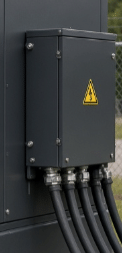
Automatic Transfer Switch Nigeria | PowerFix
An ATS decides whether your generator’s power ever reaches the building. When it fails, the generator can run perfectly and you still sit in the dark.
An automatic transfer switch in Nigeria does one job: it moves your building from grid supply to generator power when the grid fails, and back again when the grid returns, without anyone touching a switch. We’ve touched on ATS faults in our won’t start checklist and our rainy season guide. This is the full picture: how an ATS works, how to size one, what usually goes wrong, and how to test it properly.
Every ATS follows roughly the same sequence, whatever the brand:
That’s the standard sequence described in this overview of transfer switches. Grid supply Normal source
Simplified layout. Real installations also include breakers, interlocks and protection devices.
Many Nigerian sites still use a manual changeover switch, and for some small, staffed sites that’s reasonable. The difference shows up when nobody is around.
| Manual changeover | Automatic transfer switch | |
|---|---|---|
| Who switches it | A person, by hand | The ATS controller, by itself |
| Response to an outage | Depends on who is on site and how fast they react | Automatic, limited mainly by how fast the generator starts |
| Main risk | Someone has to be there, and switching back at the wrong moment or under load can cause damage | Wrong settings or an untested switch that fails when you need it |
| Suited to | Small sites that are staffed at all times | Unattended sites, critical loads, and anywhere an outage cannot wait for a person |
Most ATS units are open transition, also called break before make. The switch disconnects one source before connecting the other, so there is a brief interruption during the changeover. For most commercial and industrial sites, that’s perfectly acceptable.
A closed transition switch is make before break. For a fraction of a second, typically under 100 milliseconds, both sources are connected in parallel, so the load never sees an interruption. It’s used where even a momentary interruption is unacceptable, such as data centres. It needs more complex equipment, and the utility has to permit the brief paralleling of the two sources, so it’s a special case rather than a default.
Most of the delay between a grid failure and power returning isn’t the switch. It’s the generator starting, running up and reaching stable voltage and frequency. The switch itself operates quickly once the generator is ready. So if transfer feels slow, the cause is usually a starting problem or a delay setting, not a slow switch.
As an international benchmark, NFPA 110 sets 10 seconds as the maximum for its most demanding emergency systems, such as hospital life safety loads. That’s a US standard, not a Nigerian regulation, but it’s a sensible target for hospitals and any site where seconds matter.
Four time delays shape how an ATS behaves, and each should be set deliberately:
Timers that have drifted out of calibration can stop a transfer from happening even when the generator starts and runs perfectly.
A common mistake is to match the ATS to the generator’s kVA label. The switch is rated in amps, so what you need is the generator’s full load current. For a three phase generator, the formula is:
Current (A) = kVA × 1,000 ÷ (1.732 × voltage)
| Generator size | Full load current at 415 V, three phase |
|---|---|
| 60 kVA | about 83 A |
| 100 kVA | about 139 A |
| 200 kVA | about 278 A |
| 500 kVA | about 696 A |
These figures are for illustration at 415 V, so always confirm against the generator’s nameplate. Choose an ATS rated at or above the generator’s full load current, and never below the load it will carry. Then check three more things:
Where grid supply drops several times a day, an ATS does far more switching than a brochure rating assumes. Contacts wear, pit and burn, which means more heat and eventually a failure to make a clean connection. They need regular inspection, not just replacement after a failure.
If the grid comes back briefly and drops again, a short retransfer delay makes the load bounce between sources, which is hard on the switch, the generator and your equipment. The retransfer delay should be long enough to confirm the grid is genuinely stable. Voltage sensing matters too. A supply that is present but badly out of tolerance should count as failed, otherwise the ATS keeps your load on a grid that can damage equipment.
Heat, humidity and dust work their way into panels over time. Oxidised contacts and loose terminals create resistance, which creates heat and intermittent faults, the kind that appear on some days and not others. Our rainy season guide covers how moisture reaches ATS panels.
Failed voltage sensors, worn control relays and drifted timers can all stop a transfer, even when the generator is running without a problem. The generator looks healthy, and the building stays dark.
If the ATS controller has no healthy control supply, or the generator’s starting battery is weak, the start signal never completes. That looks like a generator that won’t start, which is why our won’t start checklist includes ATS checks.
A real example of why documentation matters: a commercial building in Victoria Island came to us with two Cummins generators that had never had documented load testing or ATS certification. After a full audit, both units were certified and load tested, and they’ve had zero unplanned failures in the 18 months since the contract began.
The most useful habit is a regular test under real conditions. NFPA 110 treats the transfer switch as a critical part of an emergency system and expects a monthly test that operates it from the normal source to the alternate and back again. Use the same discipline:
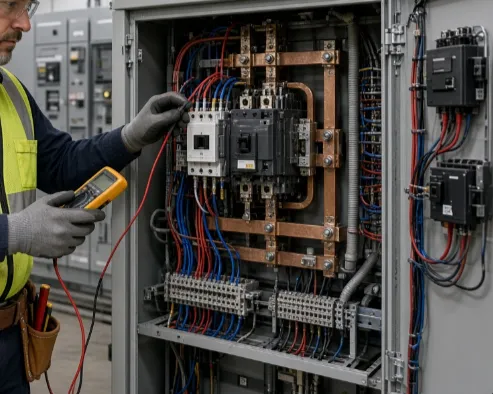
Safety. ATS panels carry live, high current. Work on them should be done by a qualified technician. Never bypass an interlock, and never connect generator power to the building without a proper changeover, because power flowing back into the grid can endanger utility workers as well as damage equipment.
An ATS problem often looks like a generator problem until someone checks the whole chain. Knowing your run hours, service history, and any symptoms you’ve noticed is the quickest way to tell which part of the chain needs attention.
Run a free PowerFix Digital Monitor check, get your generator’s health score in under 2 minutes.
Head to the PowerFix Digital Monitor tool, or see how PowerFix’s Annual Maintenance Contracts put your generator, and the switch that connects it, on a documented schedule.